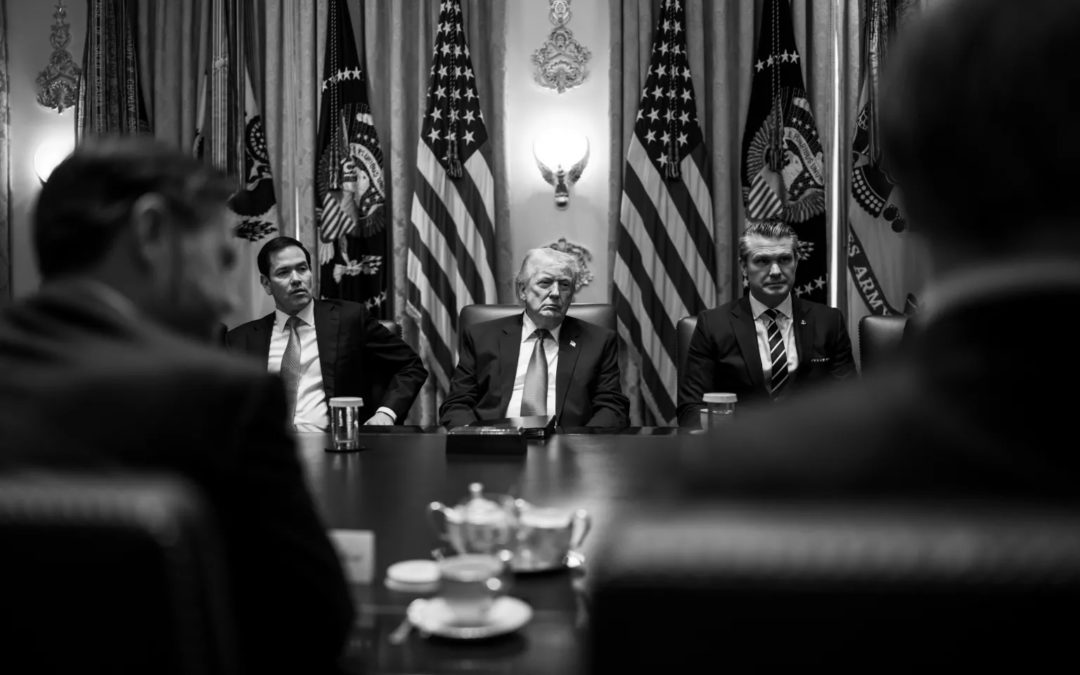
Information about the war in the Middle East is spreading at the pace of missiles launched in Iran, Lebanon, the Gulf monarchies, and Israel. Contradictory statements from American officials are delivered unfiltered, leaving everyone to decipher their meaning. One thing, however, is clear: the United States is isolated, trapped in a web of its own making. In his April 1 speech, Donald Trump promised to send Iran “back to the Stone Age.” Yet neither the numerous human losses nor the destruction underway or yet to come will allow him to escape the trap he has set for himself. What, then, will he do? Will he cut the Gordian knot with the sword by sending ground troops? Whatever he attempts, it will not change the outcome of the story; only its course, its duration, and the scale of the defeat remain unknown.
Brute Force
On that same day, Donald Trump also declared that he would strike Iran “with considerable force over the next two or three weeks.” As early as the following day, the Israeli-American coalition carried out its threat. The strikes targeted civilian infrastructure across the country: a highway bridge linking Tehran to Karaj was hit twice, following the now well-established “double-tap” method—a first strike, followed by a second approximately an hour later, when rescue workers are on site. Universities and industrial zones were also destroyed.
At the same time, Israel also decided to send the Lebanese “back to the Stone Age,” with massive attacks and destruction in southern Lebanon and in Beirut, affecting civilian areas and historical heritage sites. This is a deliberate and self-destructive strategy, as the Iran–Hezbollah–Houthi axis responds blow for blow against Tel Aviv.
An Extension of Gaza
At this stage, the deadlock is total. To understand how the trap closed, one must return to the context of this maze from which Washington will not emerge unscathed. The U.S. administration made numerous mistakes—overestimating its own power and underestimating that of its adversary (see the latest Iveris note)—but one of its major errors was forming a coalition with Israel. From the very first day, the conflict was politically lost. Indeed, this symbolic alliance automatically placed the February 28 offensive in continuity with the Gaza conflict.
For decades, the Palestinian question has been a major political and emotional marker. However, the last two years of this war have, more than ever, shaped public opinion far beyond the Middle East. A large part of the world has witnessed, in real time, the suffering inflicted on the Palestinian population. In the Arab world, the impact is even deeper.
The only actors who provided active support to the people of Gaza—who are nevertheless Sunni—have been Shiite forces: Iran, Lebanese Hezbollah, and the Yemeni Houthis. Arab public opinion now sees them as avengers, defenders of the oppressed. In Egypt, for example, 99% of the population is not only vehemently opposed to Israeli policy but is openly pro-Iranian. To a lesser extent perhaps, but broadly speaking, the same phenomenon can be observed across Muslim countries and even in Africa.
It is therefore not surprising that, on the scale of hostility, the United States has returned to levels seen during the Bush era. The Trump administration is aware of this, as according to The Guardian, it has asked its embassies to form teams to counter anti-American propaganda on the X network.
On the other side, Tehran is playing on velvet and is making full use of the situation. In one of its many propaganda videos, entitled “A Revenge for All,” animated Playmobil-style figures depict African slaves, Native Americans, prisoners from Abu Ghraib in Iraq, Afghans, and Palestinians. Missile strikes are presented as a global act of revenge for all victims of “imperialism.”
Desperately Seeking a Coalition
The other dimension of the trap is the isolation in which Trump has found himself. After fifteen days of conflict, with nothing going as planned, the Trump administration attempted to rally all its allies. It first called on Europeans for help, officially to secure the Strait of Hormuz—which, incidentally, was not closed before the conflict began. But this initiative came too late. European capitals had no desire to share the risks or to pool in the looming defeat. Spain gave a firm refusal; the others skillfully hedged, but the result was the same. Donald Trump tried everything to change their minds: pressure, then direct threats—leaving NATO, suspending military aid to Ukraine, letting them handle the Strait of Hormuz on their own. Nothing worked.
Asian allies were also called upon, notably Japan, South Korea, and Australia. Although they are among the most affected by the energy crisis linked to the closure of the Strait of Hormuz, they adopted the same stance as the Europeans: Tokyo replied “not for now,” Seoul “takes note.” Only the government in Canberra publicly stated that it would take “no offensive measures” against Tehran.
That left the Gulf monarchies, all of which host U.S. bases that were targeted from the very first hours of the conflict. To decipher their roles and intentions, one must navigate murky waters, as ambiguity and double-dealing are integral to local geopolitics. A former diplomat in the region aptly summarizes the situation: “they all fear seeing Tehran emerge victorious from the confrontation and become a regional power,” but at the same time, “they are equally afraid of a wounded Iran that would generate Iraqi-style chaos for decades.” As this seasoned observer of Middle Eastern intricacies points out, “the question is what these countries fear most: financial losses, popular uprisings, Iranian strikes, or American pressure?” The answer: all of the above.
As a result, many of them yield to American pressure while remaining silent. The UAE is the most engaged alongside the Israeli-American coalition; given its demographics, it has no public opinion to manage and possesses sovereign wealth funds worth hundreds of billions of dollars that would allow it to rebuild. Nevertheless, it remains very cautious, maintaining the line: “we are defending ourselves but are not a party to the conflict; we will not allow our territory to be used for operations against Iran.” The Iranians are not fooled by this double discourse, which is why this monarchy has been among the most heavily targeted during the conflict. Qatar appears to have bet on Iran’s victory and reached an agreement with Tehran. Since March 19, it has no longer been struck on its territory.
The Moment of Truth
Doors have closed simultaneously and/or one after another. None of the White House’s attempts to break out of isolation have succeeded. At the same time, the Revolutionary Guards announced they had launched their 94th wave of missiles and drones. Meanwhile, Iranian authorities presented a bill proposing transit tolls through the Strait of Hormuz, based on the Iranian rial rather than the yuan, as has sometimes been reported. These elements point to a precise, targeted military and political strategy unfolding according to plan.
Trapped by his rhetoric of American overwhelming power, Donald Trump cannot afford to lose face—and the Iranians will show him no leniency. There is therefore a strong likelihood that he will escalate further, encouraged by the Israelis, who are not seeking a solution. Destroying Iran and plunging the region into chaos would allow them to become the sole regional power. Meanwhile, they continue settlement expansion in Palestine, maintain a low-intensity war in Gaza, and are still attempting to establish a presence in southern Lebanon.
If the Americans were to send ground troops, the effect would be comparable to that of assassinating the Supreme Leader—but multiplied many times over. In such a scenario, some monarchies could falter, giving way to a regional reconfiguration that would bear no resemblance to the “Greater Middle East” reshaping envisioned for decades by Washington and Tel Aviv.
For the United States, the moment is historic: committing ground forces and losing the battle would become its 1989 moment, comparable to the fall of the USSR. This is not a science-fiction scenario. In a single month, the Trump administration has managed the feat of driving global hostility toward America to its highest level; degrading transatlantic relations as never before; alienating its Asian allies—yet crucial in its effort to contain China; spending billions of dollars to the dismay of American voters; and endangering the global economy. Not to mention human and material losses, nor the depletion of already dangerously low ammunition stockpiles. It is not difficult to imagine what would follow in the event of a ground offensive…
Leslie Varenne